
Bathroom Mirror Size Calculator: Find the Perfect Fit
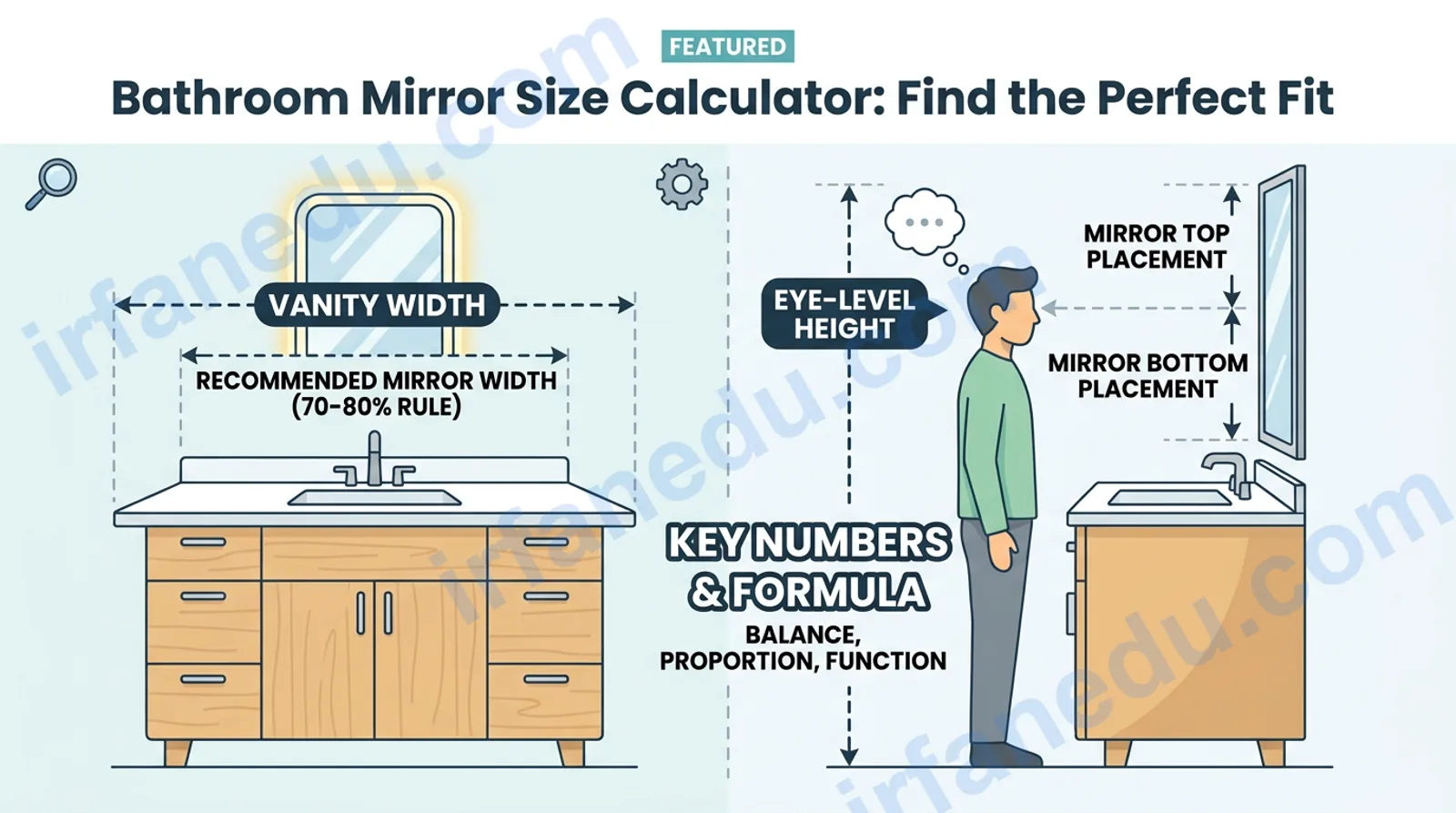
What size mirror should go above your bathroom vanity? The answer is simpler than most renovation guides make it: your mirror should be 70–80% of your vanity width, and its bottom edge should sit 5–10 inches above the vanity top. Enter your measurements below and get an instant recommendation.
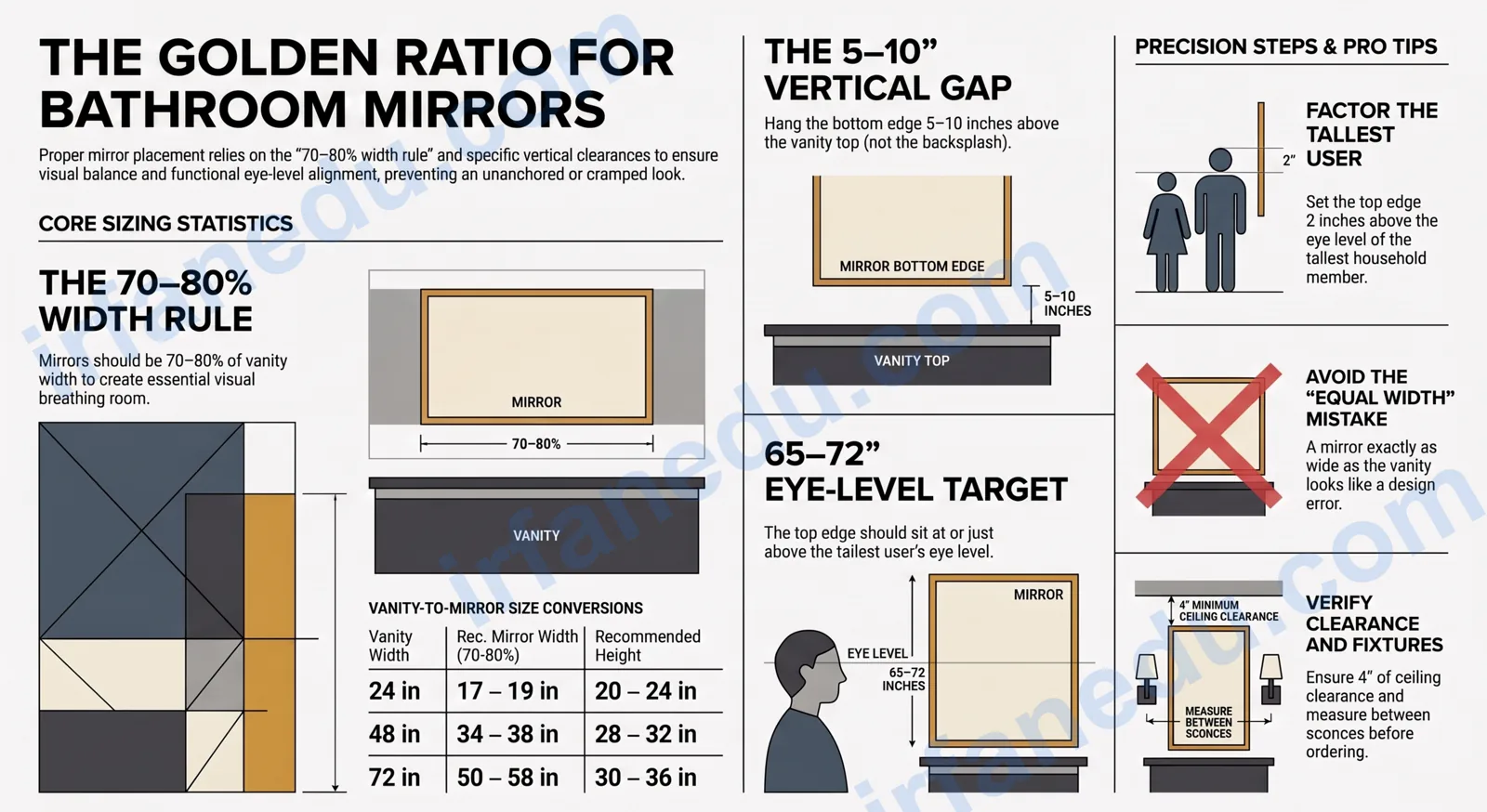
The ideal bathroom mirror width is 70–80% of your vanity width. For a 48-inch vanity, that means a 34–38 inch wide mirror. Mount it so the bottom edge is 5–10 inches above the vanity top and the top edge sits at or just above eye level (65–72 inches from the floor). A 24–36 inch mirror height suits most adults.
Bathroom Mirror Size Calculator
✅ Your Recommended Mirror Size
📝 Step-by-Step Solution
How to Use This Calculator
- Choose a mode. Use Standard to get a mirror width and height recommendation. Use Mounting Position if you already have a mirror and want to find the best hanging height.
- Measure your vanity width from left edge to right edge in inches.
- Measure the vanity top height — the distance from the floor to the top surface of the vanity (not the backsplash).
- Enter your ceiling height so the calculator can flag any clearance issues.
- Enter the eye level of the tallest person who uses the bathroom. Average adult eye level is about 65 inches.
- Click Calculate. You will see a recommended mirror width range, height, and mounting position with a numbered step-by-step breakdown.
Quick Facts: Mirror Sizing at a Glance
| Parameter | Rule of Thumb |
|---|---|
| Mirror width | 70–80% of vanity width |
| Mirror height | 24–36 inches for most adults |
| Gap above vanity top | 5–10 inches |
| Top edge height from floor | 65–72 inches (near eye level) |
| Minimum ceiling clearance | 4 inches above mirror top |
| Double-sink vanity | One wide mirror or two separate mirrors, each 70–80% of each sink section |
The Formula Explained
The bathroom mirror sizing formula uses two independent calculations: one for width and one for vertical placement. Both are based on interior design standards documented by the National Kitchen & Bath Association (NKBA).
Mirror Width (min) = Vanity Width × 0.70
Mirror Width (max) = Vanity Width × 0.80

Bottom Edge Height = Vanity Top Height + Gap (5–10 in)
Top Edge Height    = Bottom Edge Height + Mirror Height
Mirror Center      = Bottom Edge Height + (Mirror Height ÷ 2)
| Symbol | Meaning | Unit |
|---|---|---|
| VW | Vanity width (left edge to right edge) | inches |
| VH | Vanity top height from floor | inches |
| MW | Mirror width | inches |
| MH | Mirror height (vertical dimension) | inches |
| G | Gap between vanity top and mirror bottom | inches |
| EL | Eye level of tallest user | inches |
| CH | Ceiling height | inches |
SI note: All measurements above use inches (the US standard for bathroom fixtures). To convert: 1 inch = 2.54 cm. A 48-inch vanity = 121.9 cm; a 36-inch mirror = 91.4 cm.
Worked Examples
🔍 Example 1: Standard 48-Inch Single-Sink Vanity
- Vanity width = 48 in.
- Mirror width = 48 × 0.70 = 33.6 in (min) → 48 × 0.80 = 38.4 in (max). Choose a 34–38 in wide mirror.
- Vanity top height = 34 in from floor.
- Bottom of mirror = 34 + 5 = 39 in (min) from floor.
- Eye level = 65 in. Mirror top target = 65 + 2 = 67 in. Mirror height = 67 − 39 = 28 in. A 28–30 in tall mirror works well.
- Top of mirror = 39 + 28 = 67 in. Ceiling at 96 in. Clearance = 29 in. ✓
🔍 Example 2: Wide 72-Inch Double-Sink Vanity
- Vanity width = 72 in.
- Mirror width = 72 × 0.70 = 50.4 in (min) → 72 × 0.80 = 57.6 in (max). Choose a 50–58 in wide mirror (or two 24–28 in mirrors side by side).
- Vanity top height = 35 in from floor.
- Bottom of mirror = 35 + 7 = 42 in from floor.
- Eye level = 68 in. Mirror height = (68 + 2) − 42 = 28 in. A 28–36 in tall mirror is ideal.
🔍 Example 3: Compact 30-Inch Powder Room Vanity
- Vanity width = 30 in.
- Mirror width = 30 × 0.70 = 21 in (min) → 30 × 0.80 = 24 in (max). Choose a 21–24 in wide mirror.
- Vanity top height = 32 in. Bottom of mirror = 32 + 5 = 37 in.
- Eye level = 63 in. Mirror height = 65 − 37 = 28 in. A 24–28 in tall mirror fits perfectly.
🖼 Mirror Placement Diagram (side elevation)
  Ceiling ─────────────────────────────── 96 in
                                         ↑ clearance
  Top of mirror ─────────────────────── 67 in  ← near eye level
  │                                     │
  │         MIRROR                      │ 28 in tall
  │                                     │
  Bottom of mirror ──────────────────── 39 in  ← 5 in above vanity
                    ← gap (5–10 in) →
  Vanity top ────────────────────────── 34 in
  │                                     │
  │         VANITY (48 in wide)         │
  │                                     │
  Floor ─────────────────────────────── 0 in
In my experience reviewing hundreds of bathroom renovation plans, the single most common mistake is choosing a mirror that is exactly the same width as the vanity. It looks like a mistake — not a design choice. The 70–80% rule creates visual breathing room on both sides and makes the vanity look wider and more intentional. I always recommend erring toward 75% as your starting point.
Mirror Size by Vanity Width: Comparison Table
| Vanity Width | Mirror Width (70%) | Mirror Width (80%) | Recommended Height | Best For |
|---|---|---|---|---|
| 24 in | 17 in | 19 in | 20–24 in | Small powder room |
| 30 in | 21 in | 24 in | 24–28 in | Compact single sink |
| 36 in | 25 in | 29 in | 24–30 in | Single sink, standard bath |
| 48 in | 34 in | 38 in | 28–32 in | Single sink, master bath |
| 60 in | 42 in | 48 in | 30–36 in | Double sink or wide single |
| 72 in | 50 in | 58 in | 30–36 in | Double sink, master bath |
Most guides tell you to size a mirror to the vanity width — but they skip the height asymmetry problem. If two people of very different heights share a bathroom, centering the mirror at the taller person’s eye level means the shorter person sees the top of their head. The real fix is not a taller mirror — it is a mirror whose bottom edge is set at the shorter person’s chin height (roughly vanity top + 5 in), and whose top edge reaches the taller person’s eye level + 2 in. That single adjustment serves both users without needing a custom mirror. Most online calculators ignore this entirely.
📈 Explore More Calculators on IrfanEdu →
Common Mistakes to Avoid
Mistake 1: Mirror wider than the vanity. A mirror that extends past the vanity edges looks unanchored. Keep it within 70–100% of vanity width.
Mistake 2: Mounting too high. Many homeowners hang mirrors so the bottom edge is 12+ inches above the vanity. This forces shorter users to tilt their heads. Keep the gap to 5–10 inches.
Mistake 3: Ignoring light fixtures. If you have side-mounted sconces, the mirror width must fit between them. Measure the inner edge of your sconces before ordering.
Mistake 4: Forgetting the backsplash. The gap measurement starts from the top of the vanity surface, not the top of the backsplash tile. Measure correctly or the mirror will sit too low.
I have seen beautiful vanities ruined by a mirror that is 2 inches too wide. The fix costs nothing at the planning stage and a lot at the return stage. My rule: always round down to the nearest standard mirror size when you are between two options. A slightly smaller mirror always looks more intentional than one that is slightly too large.
Frequently Asked Questions
Should a bathroom mirror be the same width as the vanity?
No. A bathroom mirror should be 2–4 inches narrower than the vanity on each side, making the mirror 70–80% of the vanity width. A mirror the exact same width looks cramped and leaves no visual breathing room on either side.
How high should a bathroom mirror be hung?
The bottom edge of the mirror should sit 5–10 inches above the vanity top (or backsplash). The top edge should ideally be at or just above eye level — roughly 65–72 inches from the floor for most adults. This ensures comfortable viewing for the majority of users.
What is the standard bathroom mirror height?
Standard bathroom mirrors are 24–36 inches tall. For a single-sink vanity, 24–30 inches is common. For a double-sink or wide vanity, 30–36 inches gives better vertical coverage and visual proportion above the larger fixture.
Can a bathroom mirror be wider than the vanity?
Technically yes, but it is not recommended. A mirror wider than the
Sources & References
Written and fact-checked by Dr Irfan Mansuri. External links open in a new tab and are provided for further reading and verification.