
Traffic Laws Practice Test
What is in this test
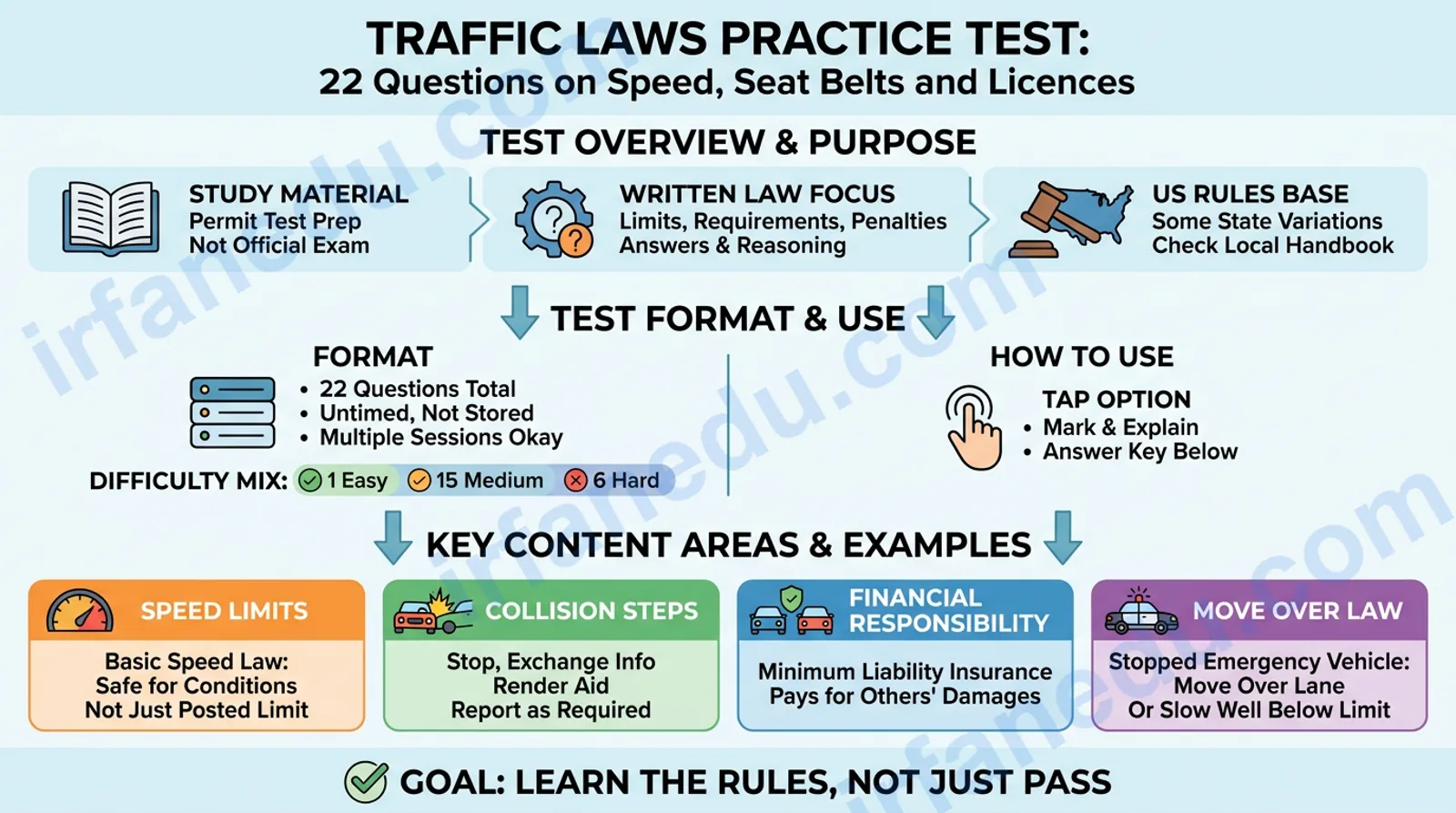
Tap an option and the page marks it and opens the explanation. Nothing is timed and nothing is stored, so you can work through it in one sitting or come back to it. If you would rather not tap through, every answer is also listed in the answer key at the bottom.
| Subject | Questions |
|---|---|
| Traffic laws | 22 |
Difficulty mix: 1 easy, 15 medium, 6 hard. The questions run easiest first.
The 22 questions
The basic speed law says that you must:
Show the answer
Correct answer: A. Never drive faster than is safe for the current conditions, even if that is below the posted limit
The posted limit is a ceiling for ideal conditions only. In fog, rain, heavy traffic, or roadworks the safe speed is lower, and you can be cited for driving too fast for conditions while still under the posted number.
If you are involved in a collision, you are legally required to:
Show the answer
Correct answer: A. Stop, exchange information, render reasonable aid, and report the crash as your state requires
Failing to stop is a serious offense in every state, and a felony where someone is injured. Exchange name, address, license, registration, and insurance details, help anyone hurt, and file a report if injuries or damage exceed your state’s threshold.
Financial responsibility laws require every driver to:
Show the answer
Correct answer: C. Carry at least the state minimum liability insurance or an approved alternative
Liability insurance pays for injury and damage you cause to others. Driving without it typically brings fines, license and registration suspension, and personal liability for every dollar of damage.
A graduated driver licensing (GDL) program typically restricts a new teen driver from:
Show the answer
Correct answer: B. Driving late at night and carrying young passengers, for a set period
GDL phases in full driving privileges. The common restrictions are a night-time curfew and a limit on teen passengers, because both sharply raise crash risk for inexperienced drivers. Restrictions lift with age and time held.
A learner’s permit holder must normally drive:
Show the answer
Correct answer: A. Accompanied by a licensed adult supervising driver in the front passenger seat
A permit authorizes supervised practice only. The supervising driver must be a licensed adult, usually 21 or older, seated where they can take control. Driving unsupervised on a permit normally voids it and delays your license.
You must notify the licensing agency when:
Show the answer
Correct answer: D. You change your address or name
Most states require notice of an address change within about ten to thirty days. Official notices, including suspension letters, go to the address on file, and not receiving one is not a defense.
Child passenger safety laws generally require that:
Show the answer
Correct answer: D. Children use an appropriate car seat or booster based on age, height, and weight, and ride in the back seat while young
Requirements step up from rear-facing to forward-facing to booster and finally to an adult belt, keyed to size rather than age alone. An airbag can seriously injure a small child, which is why the back seat is required while young.
Driving with a suspended license typically results in:
Show the answer
Correct answer: D. Extension of the suspension, heavy fines, possible vehicle impoundment, and possible jail
Driving on a suspension is treated as a serious offense because it shows disregard for a court or agency order. It usually extends the suspension and, in many states, carries jail exposure even on a first offense.
Documents you must be able to produce when stopped by a police officer usually include:
Show the answer
Correct answer: B. Your driver’s license, vehicle registration, and proof of insurance
Keep the registration and insurance card in the vehicle and your license on you. Many states now accept an electronic insurance card. Have them ready before the officer reaches your window, and keep your hands visible.
In a school zone during posted hours, you must:
Show the answer
Correct answer: C. Reduce to the posted school zone speed limit and watch for children and crossing guards
School zone limits, often 15 to 25 mph, apply during posted hours or when children are present. Fines are commonly doubled, and a crossing guard’s hand signals must be obeyed like those of a police officer.
Work zone traffic fines are commonly:
Show the answer
Correct answer: A. Doubled or otherwise increased
Most states double fines in a work zone, and many apply the increase whether or not workers are visible at that moment. Reduced limits stay in force until an END ROAD WORK sign.
When must you turn on your headlights?
Show the answer
Correct answer: C. From dusk to dawn, and whenever visibility is poor or your wipers are in use
The general rule is from about half an hour after sunset to half an hour before sunrise, plus any time visibility drops below roughly 1000 feet. Many states also require headlights whenever the wipers are running.
You are pulled over by a police officer at night. The safest way to behave is to:
Show the answer
Correct answer: C. Stop in a safe spot, turn on the interior light, keep your hands visible on the wheel, and wait
Turn off the engine, roll the window down, and keep your hands where they can be seen. Tell the officer before reaching for documents rather than moving first and explaining after.
Studies of vehicle registration and licensing show that driving records are used by:
Show the answer
Correct answer: A. Licensing agencies, courts, and insurers assessing risk
Points and convictions follow you well past the ticket. Insurers price directly off the record, so a single serious violation can cost far more in premiums than in fines.
A permit holder is stopped while driving alone. The usual consequence is:
Show the answer
Correct answer: C. A violation that can void the permit and delay the full license
A learner permit authorises supervised practice only. Driving unsupervised usually restarts the holding period and can add points before the driver even has a license.
Riding in the cargo bed of a pickup truck on a public road is:
Show the answer
Correct answer: B. Prohibited or heavily restricted in most states, especially for minors
There is no restraint in a cargo bed, and occupants are thrown out in even a modest crash. Most states ban it outright for minors and many ban it for everyone on public roads.
Points are added to a driving record in order to:
Show the answer
Correct answer: B. Track repeat violations and trigger suspension when a threshold is reached
Each moving violation adds points that stay on the record for a set period. Reaching the threshold brings a hearing, probation, or suspension, and insurers treat points as a direct signal of risk.
A minimum speed limit posted on a highway means:
Show the answer
Correct answer: A. Driving below that speed without cause obstructs traffic and can be cited
Unusually slow vehicles force others to overtake, which is when collisions happen. If conditions or a mechanical problem force you below the minimum, use your hazard lights and leave the highway at the first opportunity.
Your vehicle must be equipped with:
Show the answer
Correct answer: B. Two working headlights, tail lights, brake lights, turn signals, mirrors, and a horn
Equipment laws set a minimum for safe operation, and an officer can cite you or order the vehicle off the road for a defect. A burned-out bulb is one of the most common reasons for a traffic stop.
If your vehicle breaks down on a highway, you should:
Show the answer
Correct answer: C. Move it as far off the roadway as possible, turn on hazard lights, and wait away from the traffic side
Get the vehicle beyond the shoulder if you can. Standing behind or beside a stopped vehicle on a highway is extremely dangerous. If you stay in the car, keep your belt fastened, and exit on the side away from traffic if you must get out.
A driver strikes a parked car and no owner is present. The law requires them to:
Show the answer
Correct answer: B. Leave a note with their name and contact details, and report the crash if required
Leaving without making a reasonable effort to notify the owner is a hit and run, regardless of how small the damage looks. A note with name and contact details satisfies the duty.
Most states require a vehicle’s windshield and front side windows to:
Show the answer
Correct answer: C. Meet a minimum light transmission standard so the driver remains visible and can see out
Tint limits exist so drivers can see at night and so officers can see into the cabin. Excessive tint is an equipment violation and can require removal before the vehicle passes inspection.
Answer key
Every answer in one place, in question order.
| No. | Ans | The correct option |
|---|---|---|
| 1 | A | Never drive faster than is safe for the current conditions, even if that is below the posted limit |
| 2 | A | Stop, exchange information, render reasonable aid, and report the crash as your state requires |
| 3 | C | Carry at least the state minimum liability insurance or an approved alternative |
| 4 | B | Driving late at night and carrying young passengers, for a set period |
| 5 | A | Accompanied by a licensed adult supervising driver in the front passenger seat |
| 6 | D | You change your address or name |
| 7 | D | Children use an appropriate car seat or booster based on age, height, and weight, and ride in the back seat while young |
| 8 | D | Extension of the suspension, heavy fines, possible vehicle impoundment, and possible jail |
| 9 | B | Your driver’s license, vehicle registration, and proof of insurance |
| 10 | C | Reduce to the posted school zone speed limit and watch for children and crossing guards |
| 11 | A | Doubled or otherwise increased |
| 12 | C | From dusk to dawn, and whenever visibility is poor or your wipers are in use |
| 13 | C | Stop in a safe spot, turn on the interior light, keep your hands visible on the wheel, and wait |
| 14 | A | Licensing agencies, courts, and insurers assessing risk |
| 15 | C | A violation that can void the permit and delay the full license |
| 16 | B | Prohibited or heavily restricted in most states, especially for minors |
| 17 | B | Track repeat violations and trigger suspension when a threshold is reached |
| 18 | A | Driving below that speed without cause obstructs traffic and can be cited |
| 19 | B | Two working headlights, tail lights, brake lights, turn signals, mirrors, and a horn |
| 20 | C | Move it as far off the roadway as possible, turn on hazard lights, and wait away from the traffic side |
| 21 | B | Leave a note with their name and contact details, and report the crash if required |
| 22 | C | Meet a minimum light transmission standard so the driver remains visible and can see out |
More permit test practice
Everything on this site tagged DMV lives in the DMV category.
Sources